15x20x4 Air Filters: Does Vacuuming Really Extend Life?
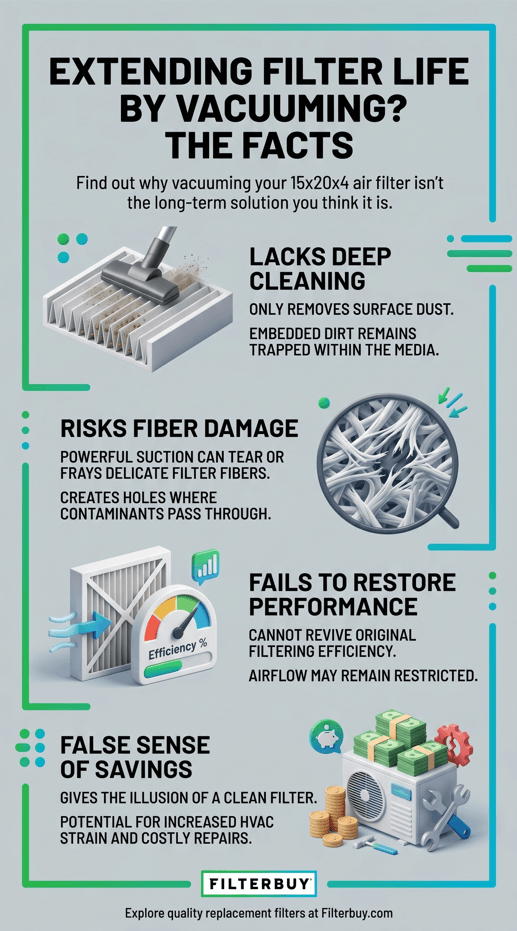
We are obsessed with the air inside your home, which is why it pains us to watch a good 15x20x4 filter get ruined by a vacuum cleaner. The dust you can see on a dirty pleated filter is the smallest part of what it holds. The particles doing real harm to your air are invisible, packed deep in the media where no shop vac will ever reach. Run a vacuum across the face to squeeze out a few more months, and you clean the part that never mattered while risking the part that did.
TL;DR Quick Answers
15x20x4 Air Filters
A 15x20x4 air filter is a four-inch deep-pleat furnace filter built to run a long time, usually six to twelve months. Vacuuming will not stretch that life in any way that counts. Suction pulls off the loose surface dust and leaves the fine particles buried in the media, and it can crush pleats or open gaps that let unfiltered air sneak past. You get more life the honest way. Buy the right deep filter, match the MERV rating to your system, and change it on schedule.
Top 5 Takeaways
Vacuuming reaches only the surface. The fine particles that actually matter stay locked inside the depth of the media.
It can do real damage. A household vacuum can crush pleats and tear fibers, which lowers the filter’s working efficiency.
Depth is life. The four-inch build is what gives a 15x20x4 filter its long run, often six to twelve months between changes.
Mind the actual size. “15x20x4” is the nominal label. The actual size is usually about 14.5 by 19.5 by 3.63 inches, so read the frame.
Four inches breathe easier. A four-inch MERV 13 restricts airflow less than a one-inch MERV 13 because it has far more media area.
What A Vacuum Reaches And What It Misses
A pleated filter is a depth filter, not a screen. Air threads through layers of fiber, and most of the particles get caught below the surface, woven deep into the media where a vacuum nozzle has no business reaching. Run a shop vac across the dirty face, and you will pull off lint, pet hair, and the loose top layer. The microscopic dust, smoke, and allergens that the filter was built to trap stay right where they are. That is why a filter you just “cleaned” still behaves like a loaded one the second you put it back to work.
Want the engineering view of how fibrous media grabs particles through interception, impaction, and diffusion? The Wikipedia overview of the air filter is a solid primer on the science working quietly inside your furnace.
Vacuuming works against you in a second way, too. The suction and the brush can collapse pleats, pull fibers loose, and disturb the static charge that many filters rely on to catch small particles. Once the pleat geometry caves in or a fiber mat tears, air takes the easy route and slips past the media through the opening. You are left with a filter that looks cleaner and performs worse, which is the opposite of what you set out to do.
15x20x4 Actual Size, MERV Ratings, And Airflow
Two numbers trip people up on this filter. The first is size. “15x20x4” is a nominal label, and the real cut size usually lands near 14.5 by 19.5 by 3.63 inches, though some brands run a full 14.5 by 19.5 by 4. If you have searched “15x20x4 actual size” or set a 14.5x19.5x3.63 air filter beside a 14.5x19.5x4 air filter, that small gap is the reason. Read the dimensions printed on the frame before you reorder. And do not count on a 15x20x4 and a 16x20x4 trading places. In the 15x20x4 vs 16x20x4 matchup, the nominal width is off by an inch, so the wrong one leaves a gap that lets air dodge the filter entirely.
The second number is MERV. For a 15x20x4 pleated air filter, the common choices are MERV 8, MERV 11, and MERV 13:
15x20x4 MERV 8 handles large dust and lint and protects the equipment.
15x20x4 MERV 11 adds finer dust, pet dander, and pollen, a fit for homes with shedding pets or mild allergies.
15x20x4 MERV 13 captures smoke, fine dust, and many allergens, which suits asthma, allergy, and wildfire-smoke households.
So does MERV 13 restrict airflow? On a thin one-inch filter, a high MERV can choke airflow and strain the blower. The four-inch design rewrites that math. All of the extra pleat area spreads the same airflow across more surface, so a 15x20x4 air filter MERV 13 breathes easier than a one-inch MERV 13 at the same rating. The best MERV rating for home use is the highest one your system fan and filter slot can handle without pressure trouble, and plenty of four-inch cabinets run MERV 13 with room to spare.
How To Actually Extend The Life Of Your Filter
Here is the part that saves money without trading away the air you breathe. A four-inch filter is already the long-life pick, so the wins come from running it well rather than cleaning a spent one.
Size and seal. Buy the right size and seal the slot so air cannot leak around the frame.
Match the MERV. Fit the rating to your system and your household.
Cut the dust at the source. Vacuum floors, wash bedding, and keep windows shut on high-pollen or smoky days.
Watch and replace. Check the filter monthly and change it on schedule, usually every six to twelve months for a four-inch filter.
Buy in volume. A 15x20x4 air filter 6 pack or bulk 15x20x4 air filters drops your cost per filter far more reliably than any cleaning trick, and a 15x20x4 air filter made in the USA gives you consistent pleat quality. If you would rather not hunt for a 15x20x4 furnace filter near me every season, scheduled delivery keeps a fresh 15x20x4 AC filter on hand.
Your filter is one piece of a bigger air system, so treat it that way. If lower energy bills are the goal, the logic that applies to your filter applies to your ductwork, which is why we walk through pairing the right filter with a clean dryer vent as a two-part efficiency fix.
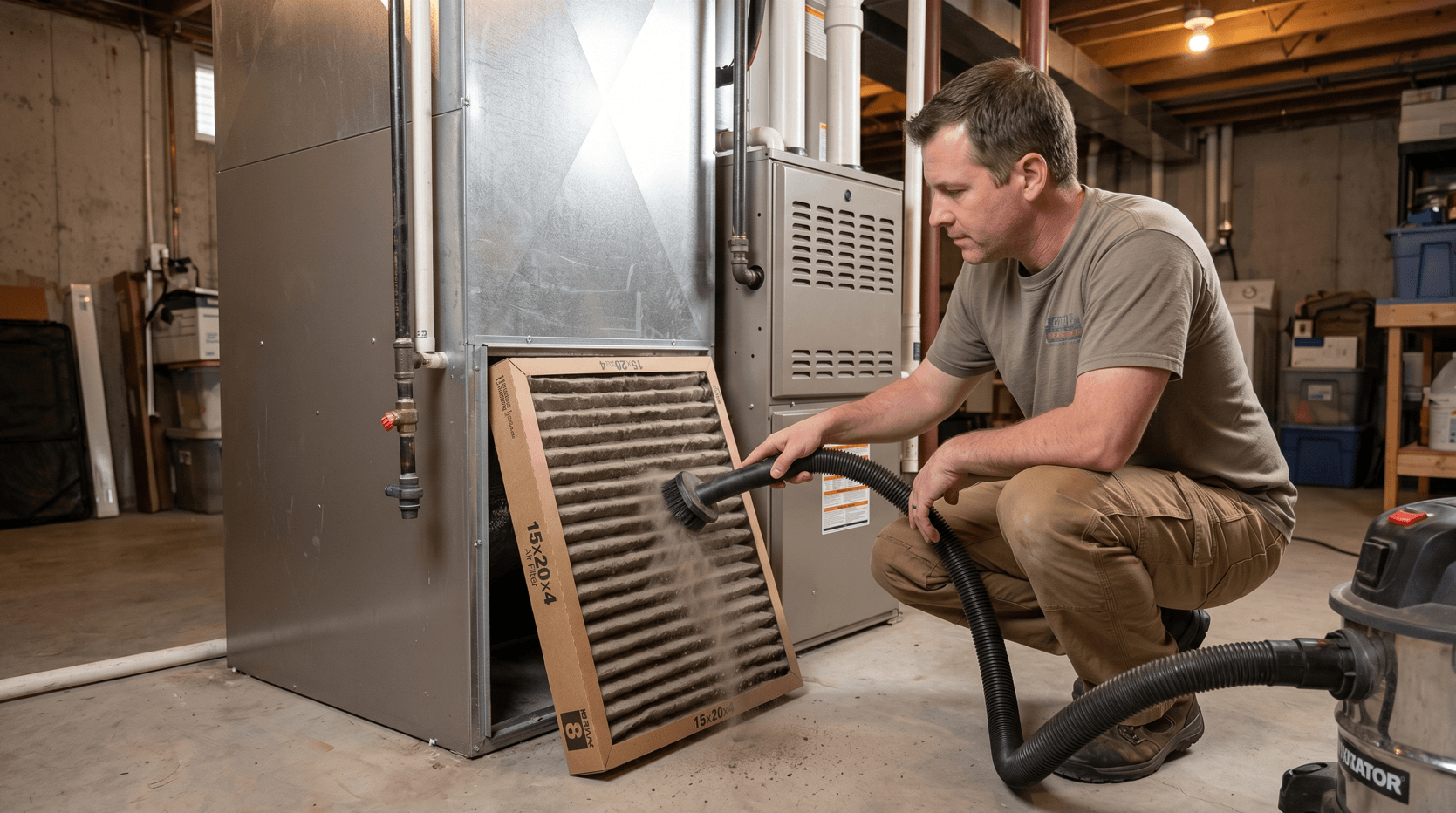
“After manufacturing filters for over a decade and serving more than two million households, we can tell you a vacuum only ever removes the dust you can see, while the particles that actually matter stay buried in the media. Fit the right deep-pleat filter for your cabinet, change it on schedule, and you get the long life you paid for without gambling on a shop vac.”
Essential Resources On 15x20x4 Air Filters
Once vacuuming is off the table, these seven sources help you buy and run a 15x20x4 filter the right way. Each is an authoritative .gov or .org page, and no two share a domain.
Keep Your System Efficient While It Filters
The U.S. Department of Energy spells out why a clean filter protects airflow and efficiency, and how often to check it during heavy heating and cooling months.
Source: U.S. Department of Energy, Air Conditioner Maintenance
Match A Filter To Asthma And Allergy Needs
The American Lung Association covers how HVAC filters clean your air and why moving toward MERV 13 helps sensitive households breathe easier.
Source: American Lung Association, Air Cleaning Guide
Understand The High-MERV Airflow Trade-Off
The Building America Solution Center digs into how higher-MERV media affects static pressure and what system design it needs, worth a read before you push a four-inch filter to MERV 13.
Source: Building America Solution Center, High-MERV Filters
Pick The Right MERV For Fine Particles
New York State’s health department lays out the MERV scale and explains why MERV 13 or higher works best on fine particles and infectious aerosols.
Source: New York State Department of Health, Indoor Air Cleaners
Learn What Filtration Does For Allergens
The Asthma and Allergy Foundation of America explains how filters and air cleaners capture allergens and where MERV fits among the ratings you will see on the box.
Source: Asthma and Allergy Foundation of America, Air Cleaners Explained
Get Allergist Guidance On Home Filtration
The American College of Allergy, Asthma, and Immunology recommends a disposable MERV 11 to 13 filter for whole-house filtration and even notes how hard it is to clean a filter well.
Source: American College of Allergy, Asthma and Immunology, Home Filtration Guidance
Read The Research On Filtration And Health
A peer-reviewed review hosted in the National Institutes of Health library summarizes the evidence on how air filtration affects allergic respiratory disease, for readers who want the science behind the advice.
Source: National Institutes of Health, Filtration and Respiratory Health Review
Supporting Statistics
Three figures put the vacuuming question in perspective. Each comes from a separate .gov source, none repeated from the resources above.
Most of life happens indoors. The EPA reports that Americans spend about 90 percent of their time indoors, where some pollutants run 2 to 5 times higher than outdoor levels. That is the air your 15x20x4 filter cleans on every cycle.
Source: U.S. Environmental Protection Agency, Indoor Air Quality
Rating decides what gets caught. A MERV 13 filter captures at least 50 percent of the smallest 0.3 to 1.0 micron particles and about 85 percent of 1 to 3 micron particles, while a common MERV 8 catches only around 20 percent in the 1 to 3 micron range. The rating changes performance. The vacuum does not.
Source: U.S. Centers for Disease Control and Prevention, Ventilation FAQs
Schedule beats cleaning. ENERGY STAR advises checking your filter monthly and replacing it at least every three months, because a dirty filter slows airflow and forces the system to work harder. A four-inch filter buys more time, yet it still has a finish line.
Source: ENERGY STAR, Heat and Cool Efficiently
Final Thoughts And Opinion
We have cut open enough used filters on our own bench to say it plainly. Vacuuming a deep-pleat filter is a false economy. It feels thrifty, and it even looks like progress, but you are trading away the protection you paid for to save the price of one filter. The dust you knock loose does not all leave the room. Some of it lands back in your air and on you, which is the opposite of clean.
Our take, in plain terms:
A 15x20x4 filter is already the long-life choice. Let the depth do the work.
Spend your effort on sizing, sealing, and a change reminder, not on a shop vac.
Buy in bulk so the right habit becomes the easy one.
You are the one protecting the air your family breathes. The filter you can see is the smallest part of that job. The part you cannot see is the part worth protecting.
Frequently Asked Questions
Q: Can You Wash Or Vacuum A 15x20x4 Pleated Filter And Reuse It?
A: No. Disposable pleated filters are built for one life. Vacuuming removes surface dust but leaves the embedded particles, and can damage the pleats. Washing soaks the media and ruins it. Replace it instead.
Q: How Often Should You Replace A 4-Inch Furnace Filter?
A: Usually every six to twelve months, and sooner if you have pets, allergies, heavy use, or nearby construction or smoke. Check it monthly and swap it once the pleats look loaded.
Q: What Is The Actual Size Of A 15x20x4 Air Filter?
A: The label reads 15x20x4, but the actual cut size is usually about 14.5 by 19.5 by 3.63 inches, and some brands run a full 14.5 by 19.5 by 4. Read the size printed on your frame before you reorder.
Q: Does A 15x20x4 MERV 13 Filter Restrict Airflow?
A: Less than most people fear. A four-inch MERV 13 has far more media area than a one-inch MERV 13, so it spreads airflow across more surface and breathes more easily. Confirm your system supports it before you upgrade.
Q: Is A 15x20x4 The Same As A 16x20x4 Filter?
A: No. The nominal width is off by an inch, so they do not swap. The wrong size leaves a gap that lets air slip past the filter. Match the size printed on your old frame.
Get The Right 15x20x4 Filter On A Schedule You Can Forget
Put down the shop vac and let a fresh, correctly sized 15x20x4 filter do the work your air deserves. Pick your MERV, grab a multi-pack, and set a change reminder so clean air stays one thing you never have to think about.
Learn more about HVAC Care from one of our HVAC solutions branches…
Filterbuy HVAC Solutions - Weston FL
2573 Mayfair Lane Weston FL 33327
(754) 296-3528
https://maps.app.goo.gl/E3tjmKf5VSWYghGc7